



The way people search for information online is changing faster than ever. Artificial intelligence tools like ChatGPT, Perplexity, Copilot, and others are transforming how users interact with the web.
In response to this revolution, Google has launched AI Overview, a new type of search result that offers AI-generated summaries directly on the results page. These summaries pull information from various relevant sources, but not necessarily from the pages that rank organically.
The emergence of AI Overview introduces significant changes to SEO, particularly in how it impacts different types of keywords and in the growing need to adjust tactics to maintain search visibility.
SEO and search intent: the heart of the strategy
SEO aims to rank pages on Google to attract organic traffic. However, not all keywords behave the same; their impact depends on search intent.
We can divide them into two main categories:
Transactional keywords: searches with buying intent
Transactional keywords are those a user types when they’re already set on purchasing a product or service. These terms show a clear intent to buy, and precisely for that reason, Google usually does not show AI Overview for these types of results. An automated answer could improperly influence the decision-making process and compromise the neutrality of the search.
Some examples include:
- apartments in Lima
- cars for sale
- open a savings account
- pizza delivery
- buy land in Juliaca
These searches have high commercial potential and, although AI doesn’t directly intervene in them, competition remains intense. To succeed, ranking organically is not enough—you must offer an excellent user experience, optimize your site technically, and create persuasive content that converts visitors into customers.
Informational keywords: searches to learn
On the other end of the spectrum are informational keywords. In this case, users are looking for information, not necessarily to buy. This is where AI Overview has the greatest impact, as it can summarize content from multiple pages and present it directly on Google, reducing the need for the user to click.
Examples include:
- types of apartments
- benefits of cereals
- why save money in a bank
- why invest in Juliaca
These searches require a strategy focused on high-quality content that clearly and fully responds to the user’s intent. The goal is not only to rank in traditional search results, but also to become a source that AI relies on to build its summaries. While this doesn’t guarantee immediate clicks, brand exposure and credibility grow significantly.
The impact of AI on my website
The rise of artificial intelligence affects not only SEO, but other channels as well.
After analyzing multiple websites, we found the following traffic patterns:
| Tool | Type of impacted traffic | Key observation |
|---|---|---|
| ChatGPT | Referral (Source = chatgpt.com) | The user sees the source and clicks from chatgpt.com. |
| Copilot | Referral (Source = copilot.microsoft.com) | Similar to ChatGPT but integrated into Microsoft products. |
| Gemini | Referral (Source = gemini.google.com) | Google’s AI independent from the traditional search engine. |
| Perplexity | Referral (Source = perplexity.ai) | Ideal for research and detailed content. |
| AI Overview | Direct (Source = direct) | Harder-to-track traffic; part comes from Google’s summary. |
According to our tests and analysis, the case of AI Overview is different. When Google uses your content in these summaries, the traffic is not logged as organic but as direct. This happens because the user views your information inside Google’s AI Overview, and if they choose to explore further, they do so through an internal link that isn’t classified as a traditional search click.
In other words, part of the organic traffic “turns into direct,” which can create the illusion of a drop in SEO performance—even though the content is still reaching users, just through a different channel. It’s important to note that this statement is still a hypothesis, as the system continues to evolve and Google may eventually assign a predefined source/medium for this channel. So far, Google Analytics still doesn’t assign a specific source/medium to AI Overview traffic.
Real cases: how AI Overview impacts direct traffic
Across most websites we analyzed, a pattern emerged. Here are two examples where this behavior repeated:
Case 1: Company with informational content focused on Peru
Most of its traffic came from informational SEO. After the introduction of AI Overview, organic sessions decreased slightly while direct traffic increased.

Case 2: Company with international presence
Its informational content attracted visitors from multiple countries. AI Overview used its content as a primary source, increasing global visibility, although with a slight shift in channel distribution.
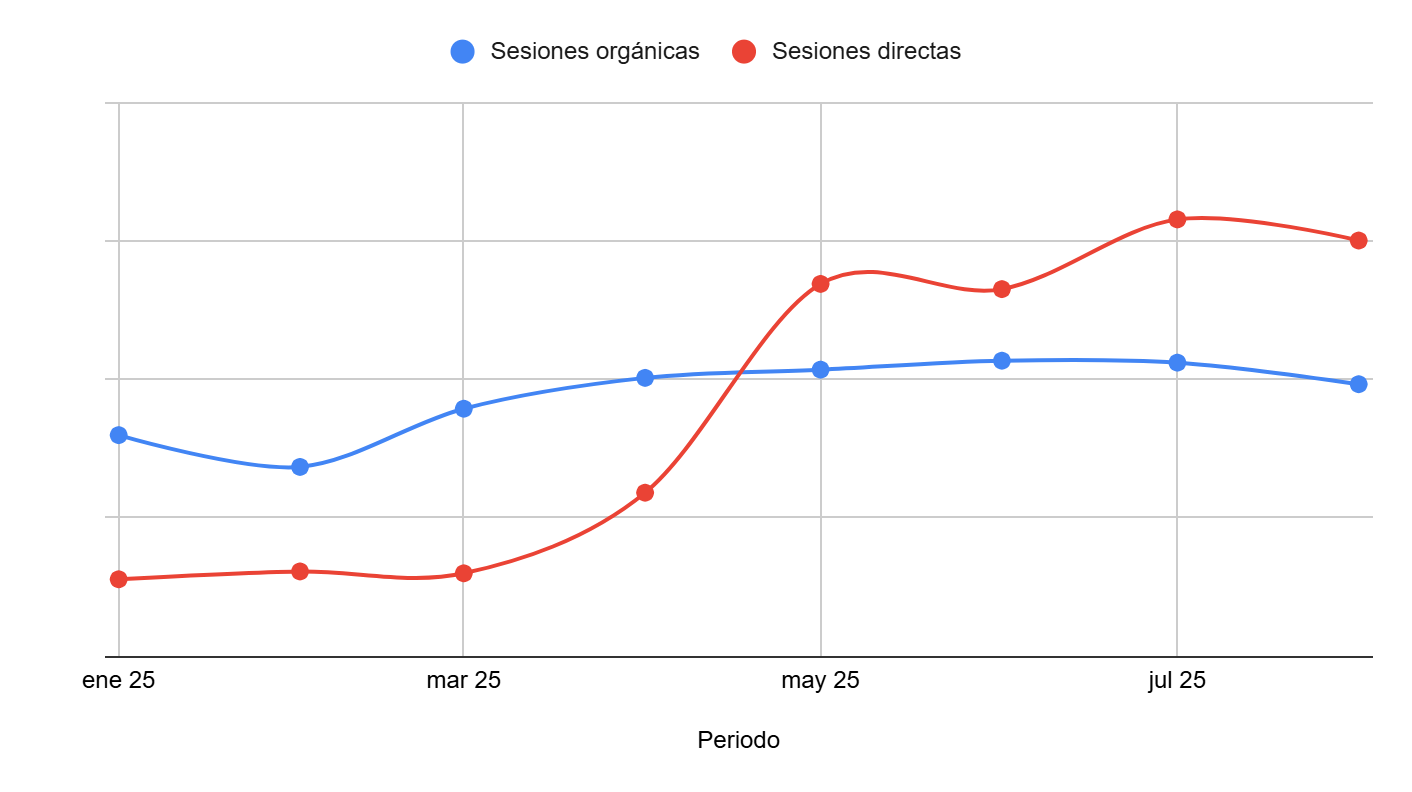
When Google uses your content in AI Overview, you still gain visibility—even if clicks arrive through different paths.
How to prepare for the AI era
Artificial intelligence does not mean the end of SEO, but it does require evolution. The key is to adapt your strategy to remain relevant and effective in this new landscape.
First, it’s crucial to strengthen your presence in transactional keywords, where AI Overview has less influence and where purchase decisions depend directly on your website’s quality and relevance. Second, informational content must be clear, structured, and trustworthy so that Google and other AI models consider it reliable enough to use as a reference.
Additionally, it’s important to analyze direct traffic carefully to identify changes that could be connected to AI-generated summaries. Finally, remember that attracting visitors is not enough—you need a website optimized to convert that traffic into sales or leads.
SEO isn’t dying—it’s transforming
The arrival of AI Overview and other artificial intelligence tools is redefining SEO rules. Instead of viewing these changes as a threat, businesses that adapt quickly will be able to leverage new forms of visibility and build a competitive advantage.
